


Building Confidence through real-world experience
Name and identifying details have been changed to protect privacy.
When Ethan first began exploring employment opportunities, he knew he wanted a hands-on career but often depended on others to help him take the next step. He had great work ethic, but navigating job searches, interviews, and new situations on his own felt uncomfortable and overwhelming.
Before
Ethan struggled with self-initiation and independence. During job searches and interviews, he often relied heavily on his support team and his mother for guidance. Communication was difficult at times. He tended to avoid eye contact, spoke quietly, and lacked confidence when interacting with unfamiliar people.
Although he had an interest in hands-on work, pursuing opportunities independently was a challenge. Taking the first step often felt harder than the task
itself.
Participation
Over time, Ethan participated in job exploration and work readiness coaching. He practiced communication skills, prepared for interviews, and gradually took more ownership of the employment process.
As opportunities arose, he applied for positions, attended interviews, and continued building experience through participation rather than observation.
Eventually, Ethan completed a Work-Based Learning Experience with Aloha Fence. The experience placed him in a real work environment where he was expected to communicate with supervisors, learn new tasks, and contribute alongside other employees.
Discovery
Through these experiences, Ethan began to discover that confidence is not something that appears all at once. It develops through showing up, trying new things, and working through discomfort.
As he became more involved in the workplace, he realized he was capable of handling situations more independently than he had previously believed.
During his time at Aloha Fence, another discovery emerged. His employer noticed that Ethan had strong welding abilities—skills that had not been fully recognized before. What began as a work experience became an opportunity for others to see strengths that Ethan himself may not have fully appreciated.
He also learned that effective communication is a skill that improves with practice. As his comfort level grew, so did his ability to interact with supervisors and coworkers.
Today
Today, Ethan is more confident and independent than when he first began his employment journey.
He successfully completed his Work-Based Learning Experience and developed a reputation as a reliable employee. His communication skills improved, and he became more comfortable navigating workplace expectations and responsibilities.
The recognition he received for his welding abilities provided another layer of confidence and helped highlight a strength that may influence future employment opportunities.
While he continues to learn and grow, Ethan leaves the experience better prepared for future work and with a clearer understanding of what he is capable of contributing.
Reflection
Growth does not always arrive through dramatic moments. Sometimes it develops through repeated participation in everyday experiences.

Learning to Follow Through
Name and identifying details have been changed to protect privacy.
When Olivia first began working with MMC, she was a bright and capable student who genuinely wanted to do well in school. Like many students, she started the school year with good intentions and a desire to stay on top of her responsibilities.
Over time, however, keeping up became more difficult. As assignments, deadlines, activities, and expectations increased, she found herself struggling to maintain the systems needed to stay organized and follow through consistently.
Before
Olivia was intelligent and capable, but completing schoolwork consistently was a challenge.
Assignments were often forgotten or postponed until later. A missed assignment would turn into several. Deadlines became harder to manage. As work accumulated, catching up felt increasingly overwhelming.
Like many students in similar situations, there was usually a reason. Sometimes she forgot. Sometimes she intended to do the work but became distracted. Sometimes the task simply felt too difficult or uninteresting to start.
As the school year progressed, the gap between what she was capable of doing and what she was actually completing continued to grow.
Subjects such as math became increasingly frustrating. Falling behind made new concepts harder to understand, which made it even more difficult to engage with the work.
School began to feel like a constant cycle of trying to catch up.
Participation
Rather than focusing only on grades, Olivia began developing skills that supported follow-through.
She worked on creating routines, improving organization, prioritizing responsibilities, and identifying strategies that helped her maintain focus. She began paying closer attention to how she managed her time and what tended to pull her away from important tasks.
Some approaches worked better than others. Through trial and error, she discovered methods that fit her learning style and daily life.
The process was not always exciting. Much of the work involved completing assignments that were difficult, repetitive, or simply not very interesting.
But instead of waiting until she felt motivated, Olivia gradually learned how to take action even when she didn't feel like it.
Assignment by assignment, class by class, she began rebuilding momentum.
Discovery
Through the process, Olivia discovered that her struggles were not a reflection of her intelligence.
She was capable.
What she lacked were systems and habits that helped her consistently follow through on her intentions.
She began noticing how small actions taken consistently created a different experience than waiting until problems became urgent.
She also learned that confidence often follows action rather than preceding it. The more she completed, the more capable she felt. The more capable she felt, the easier it became to continue moving forward.
Most importantly, she realized that progress did not require perfection. It required
participation.
Today
By the end of the school year, Olivia had developed stronger routines and a greater ability to manage her responsibilities.
She caught up on missing work, improved her grades, and successfully passed her classes.
The work was not always easy, and there were still assignments she would have preferred not to do. The difference was that she had developed strategies that helped her keep moving forward even when the work felt difficult or boring.
As her follow-through improved, so did her confidence.
School became less overwhelming. She spent less time worrying about what she hadn't done and more time focusing on what needed to be done next.
With fewer missing assignments and less stress surrounding school, she also found herself with more time and energy for the activities she enjoyed outside the classroom.
Reflection
By developing routines, learning what worked for her, and continuing to participate even when the work was difficult, Olivia discovered that consistent effort can gradually change both outcomes and self-confidence.
Discovering Capability Through Meaningful Work
Name and identifying details have been changed to protect privacy.
When Caleb was referred to MMC through Wasatch High School, the goal was not simply to help him find work. Those who knew him believed that participating in a real-world work environment could help him build confidence, develop independence, and discover strengths that were difficult to see while navigating the challenges he faced at school and in daily life.
Before
At the time of his referral, Caleb was experiencing significant stress both at school and at home. While he had many positive qualities, he had limited work experience and few opportunities to develop workplace skills in a structured environment.
Communication, follow-through, task completion, and understanding workplace expectations were all areas where he needed support. Like many students facing similar challenges, he was uncertain about his ability to succeed in a work setting and lacked confidence in what he could contribute.
The idea of employment represented more than finding a job. It represented stepping into unfamiliar situations and learning to navigate new responsibilities.
Participation
Caleb began participating in Job Exploration and Work Readiness coaching, where he explored career interests, discussed employment opportunities, and practiced skills related to communication, responsibility, and workplace expectations.
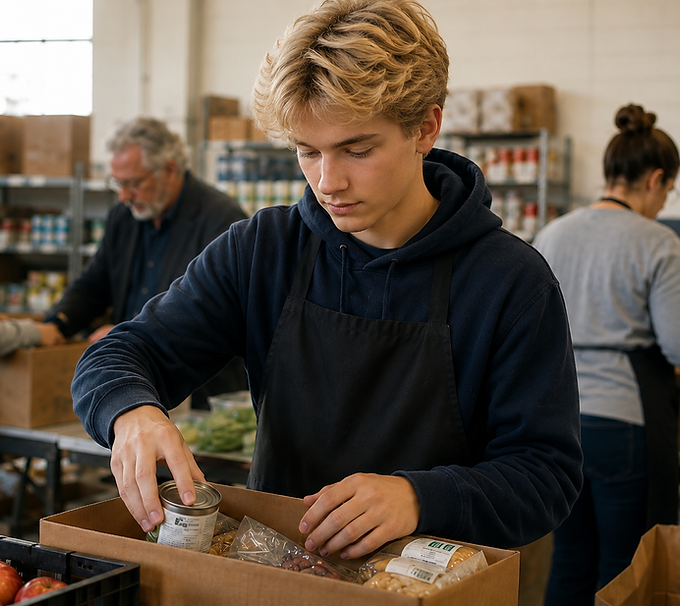
As part of this process, he started volunteering at the CCPC Food Bank. What began as an opportunity to gain experience soon became a place where he could actively contribute alongside others who were serving the community.
Over time, his involvement grew into a Work-Based Learning Experience at CCPC. Through regular participation, Caleb learned what it meant to show up consistently, complete assigned tasks, work with a team, and contribute to a larger purpose.
He also encountered practical challenges along the way. Transportation was often complicated, and unlike many students his age, he did not have a cell phone to help coordinate rides or communicate changes. Rather than allowing these obstacles to prevent participation, he learned how to navigate them and find solutions.
Discovery
Through his work at the food bank, Caleb began discovering something important about himself.
He learned that he could be counted on.
By showing up regularly and following through on responsibilities, he began building trust with the people around him and confidence within himself.
He discovered that meaningful work is not always about the task being completed. Sometimes it is about knowing that your effort contributes to something larger than yourself. Serving individuals and families through the food bank gave him opportunities to see the value of his contribution and the impact of consistent effort.
As challenges arose, he also learned that obstacles could be worked through rather than avoided. Transportation issues, workplace expectations, and day-to-day responsibilities became opportunities to practice problem-solving and independence.
Most importantly, he began to see himself differently—not as someone struggling with challenges, but as someone capable of meeting them.
Today
By the conclusion of his Work-Based Learning Experience, Caleb had established himself as a dependable and hardworking member of the team.
He consistently arrived on time, completed assigned tasks, and demonstrated a strong work ethic. The confidence he gained through participation was evident in the way he approached responsibilities and interacted with others.
Despite transportation barriers and limited resources, he continued showing up and finding ways to make it work. Those experiences strengthened both his independence and his belief in his own capabilities.
His growth and commitment led to a recommendation for Vocational Rehabilitation Services so he could continue building on the progress he had made and pursue future employment opportunities with additional support.
Reflection
Confidence often develops quietly. It grows through responsibility, consistency, and participation in everyday experiences.